
mrwreads.blogspot.com
Thursday, November 20, 2014
Hurricane Cleanup
Hurricanes, with winds over 74 miles per hour, can cause a lot of damage. This video shows just some of the things that need to be done in a house that has been damaged by a hurricane. It certainly looks like cleaning up this damage could take a long time.

Wednesday, November 19, 2014
Tracking Hurricanes
Meteorologists take information about the hurricane like wind speed, direction, and size, and use computers to make predictions about where a hurricane might go next. The first video shows a meteorologist's prediction about where Hurricane Gonzalo might go in October, 2014.
This second video shows us whether or not that meteorologist was right about where Hurricane Gonzalo would go.
This second video shows us whether or not that meteorologist was right about where Hurricane Gonzalo would go.
Tuesday, November 18, 2014
What is a Hurricane?
Hurricanes are very large storms that form in the ocean. This video gives a great scientific explanation of how one starts.
Thursday, November 13, 2014
Saltwater Crocodiles
Of all the animals we've read about, the saltwater crocodile is the scariest one to me. This video does nothing to make me feel better about them.
This video shows just how deadly the saltwater crocodile can be. (I plan to skip that part. It gives me the shivers.) More importantly, this video shows how gentle a saltwater crocodile can be with her babies. The most amazing fact in the video is that the saltwater crocodile's jaws are 7 times more powerful than the great white shark's jaws.
This video shows just how deadly the saltwater crocodile can be. (I plan to skip that part. It gives me the shivers.) More importantly, this video shows how gentle a saltwater crocodile can be with her babies. The most amazing fact in the video is that the saltwater crocodile's jaws are 7 times more powerful than the great white shark's jaws.
Wednesday, November 12, 2014
Giraffes
Giraffes are so tall they can eat food that other animals can't. Like the leaves in this tree.
This next video is short but gives a great view of a giraffe running. It's hard to tell how fast it is going, and it's size almost makes it look like slow motion, but giraffes can run up to 30 miles per hour!
A giraffe's size is pretty amazing, and when it comes to eating food, quite helpful. But what about when it needs to get a drink? There aren't any ponds or streams at the tops of trees.
Tuesday, November 11, 2014
Ostriches
Ostriches are the largest birds and the fastest birds on land. How big are they? Take a look at this video. (Did you know that ostriches, like cows, are raised for their meat? And, like chickens, their eggs can be used for food too?)
This video shows and explains just how fast an ostrich can run.
This video shows and explains just how fast an ostrich can run.
Thursday, November 6, 2014
The Julian Chapter Read Aloud Resources

Many, many classrooms have read Wonder aloud in their classrooms, and rightfully so. Last school year (2013-2014) was no different for us. We started our fifth graders’ year by reading Wonder, and just like countless other classrooms around the country and the world, we used its lessons and themes as a basis for building a strong classroom community. When The Julian Chapter was released in May, 2014 we thought it would be great opportunity to revisit those lessons.
So just like I did for Wonder, I put together some online resources. Once again we used the songs, quotes, and images from the story - along with the occasional mini-lesson - to enhance our reading and understanding of the story. And once again, you are invited to use these resources with your students as well.
Below are links to the original Wonder resources and the added resources for The Julian Chapter. I hope they add to your enjoyment and understanding of both texts.
Thanks for reading and thanks for stopping by this little corner of the web. If you have any questions, comments, or suggestions please feel free to share them.
Page numbers refer to the text as it appears in Auggie & Me by R. J. Palacio.
Wednesday, November 5, 2014
Elephants
In order to describe an elephant's size, our book compares elephants to cars. It says that elephants are as tall as three cars stacked on top of one another. What better way to see that than from a car? Watch this elephant walk right past this car. Also, listen to what one child says about its size right at the end.
Here's another video of an elephant walking by a family in a van. (Although I'm not sure about the "please tip the van" comment.)
Here's another video of an elephant walking by a family in a van. (Although I'm not sure about the "please tip the van" comment.)
Tuesday, November 4, 2014
Blue Whales
Blue whales are fascinating creatures. This first video just shows some footage of blue whales swimming by divers. What would it be like to have something like that swim past you?
This second video shows blue whales eating, which basically is them swimming with their mouths open. What are they really doing?
Finally, this last video gives some scientific explanations about why blue whales are so big. How can they get that big? Here's how:
Finally, this last video gives some scientific explanations about why blue whales are so big. How can they get that big? Here's how:
Wednesday, October 29, 2014
Dinosaurs
Not all dinosaurs are ferocious and meat-eating or ginormous and plant-eating. Some are just little guys. Like the saltopus.
Yesterday we watched two videos about large plant-eating dinosaurs, but here is a little more about the brachiosaurus. I just thought this guy was sort of funny and goofy looking.
Yesterday we watched two videos about large plant-eating dinosaurs, but here is a little more about the brachiosaurus. I just thought this guy was sort of funny and goofy looking.
Friday, May 23, 2014
The Julian Chapter: After - Pages 72-96, The End
Remember the quote from Lord of the Flies? It said, "Fear can't hurt you any more than a dream." In his email Mr. Browne said that maybe Julian was a little afraid of Auggie. Now Grandmère says that she thinks Mr. Browne was right, that Julian was afraid of Auggie. Julian, of course, denies it.
What do you think?
World War II was fought between 1939-1945. Germany was the main enemy in Europe. Paris was occupied by Germany in 1940. (This is the same as Germany occupying Denmark in Number the Stars.)
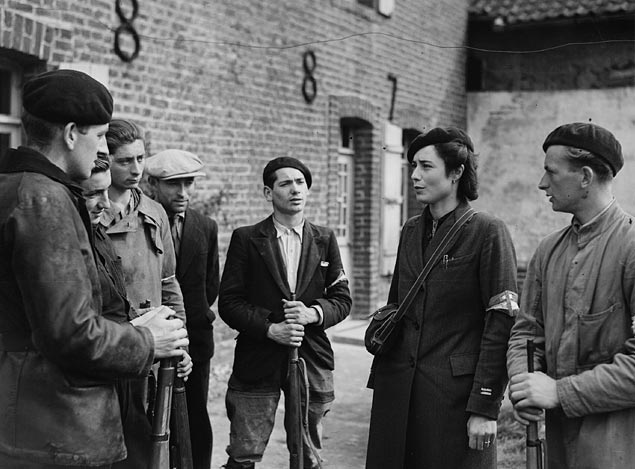
The Maquis were groups of French Resistance Fighters. These were people who escaped to the mountains to avoid being forced into the German army and then fought back against them. Members were called maquisards or "armed resistance fighters." Partisan is another name for these fighters. As you can see in this image, they don't really look like soldiers.
According to Wikipedia (I'll leave the more in depth research to you.) there were about 200,000 Jewish people in Paris at the time. The Germans began passing laws against Jews in September of 1940, and they began taking Jews away in May of 1941. This continued until August of 1944. During this time nearly 76,000 Jews were taken from Paris and only 2,500 survived. (More on this later.)
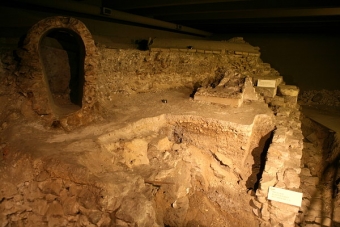
Grandmère says her school had a chapel, which is a room like a church used for worship services, and behind that there was a crypt. A crypt is an underground room used for worship or as a burial site. This example is underneath the Notre Dame cathedral in Paris.
The sewers in Paris at the time, to the best of my understanding, were basically tunnels where waste drained out of the city and emptied into fields outside of Paris, so following the sewers would eventually lead to an open field, many times by a village. Today there are museums and tours you can take to see the sewers. Here are some examples of what the sewers look like.


Grandmère lived and went to school in Aubervilliers which is just north of Paris.
Auschwitz was a concentration camp. When Jews were deported, they were taken to concentration camps. There they were held prisoner, forced to work, and most were executed. At least 1.1 million people were killed at Auschwitz.
What do you think?
World War II was fought between 1939-1945. Germany was the main enemy in Europe. Paris was occupied by Germany in 1940. (This is the same as Germany occupying Denmark in Number the Stars.)
The Maquis were groups of French Resistance Fighters. These were people who escaped to the mountains to avoid being forced into the German army and then fought back against them. Members were called maquisards or "armed resistance fighters." Partisan is another name for these fighters. As you can see in this image, they don't really look like soldiers.
 |
| photo source |
According to Wikipedia (I'll leave the more in depth research to you.) there were about 200,000 Jewish people in Paris at the time. The Germans began passing laws against Jews in September of 1940, and they began taking Jews away in May of 1941. This continued until August of 1944. During this time nearly 76,000 Jews were taken from Paris and only 2,500 survived. (More on this later.)
Grandmère says her school had a chapel, which is a room like a church used for worship services, and behind that there was a crypt. A crypt is an underground room used for worship or as a burial site. This example is underneath the Notre Dame cathedral in Paris.
 |
| photo source |
The sewers in Paris at the time, to the best of my understanding, were basically tunnels where waste drained out of the city and emptied into fields outside of Paris, so following the sewers would eventually lead to an open field, many times by a village. Today there are museums and tours you can take to see the sewers. Here are some examples of what the sewers look like.


Grandmère lived and went to school in Aubervilliers which is just north of Paris.
Auschwitz was a concentration camp. When Jews were deported, they were taken to concentration camps. There they were held prisoner, forced to work, and most were executed. At least 1.1 million people were killed at Auschwitz.
 |
| The main gate says "Work Makes Free" - photo source |
 |
| Prisoners forced to work - photo source |
 |
| This shows how big the camp was. photo source |
The Germans didn't only take Jews. They took people that they felt were not perfect. This included people with mental and physical disabilities, gypsies, deaf people, people who disagreed with them politically, and some people with other religious beliefs. At many concentration camps, the people who were taken there were killed in gas chambers. This means they were forced to breathe poison gas.
Julian says that in his dream the Nazi officials looked like Darth Vader's Imperial officers. What do you think?

Julian says that in his dream the Nazi officials looked like Darth Vader's Imperial officers. What do you think?

 |
| Darth Vader's Imperial officers. photo source |
Wednesday, May 21, 2014
The Julian Chapter: After - Pages 61-71
The second section of The Julian Chapter also begins with two quotes. The first is from The Jungle Book by Rudyard Kipling.
In The Jungle Book Mowgli is raised by wolves and is accepted as a member of the pack and a part of the jungle, although not without some conflict. In time Mowgli realizes that he must leave the jungle and live with people. He is crying because he must leave everything he knows. In this quote Bagheera is telling Mowgli that he is no longer a child (man-cub) but a man. Mowgli has grown up, and he must leave the jungle (and his childhood) behind. How might this foreshadow what is coming in After?
The second quote is from the song "The Partisan" by Leonard Cohen. It reads:
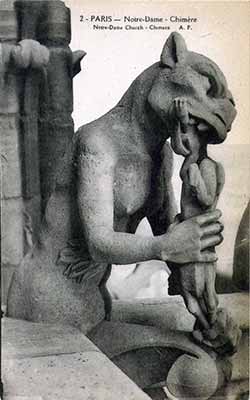
Here are two actual postcards featuring the gargoyles.
"That is only tears such as men use," said Bagheera.
"Now I know thou art a man, and a man's cub no longer.
The jungle is shut indeed to thee henceforward.
Let them fall, Mowgli. They are only tears."
 |
| Original book cover - photo source |
In The Jungle Book Mowgli is raised by wolves and is accepted as a member of the pack and a part of the jungle, although not without some conflict. In time Mowgli realizes that he must leave the jungle and live with people. He is crying because he must leave everything he knows. In this quote Bagheera is telling Mowgli that he is no longer a child (man-cub) but a man. Mowgli has grown up, and he must leave the jungle (and his childhood) behind. How might this foreshadow what is coming in After?
The second quote is from the song "The Partisan" by Leonard Cohen. It reads:
Oh, the wind, the wind is blowing,
through the graves the wind is blowing,
freedom soon will come;
then we'll come from the shadows.
The song is about a French man during World War II who runs away and becomes a partisan rather than surrender to the German army. A partisan is a person who remains loyal to their country and fights against the country who has attacked them. Looking at the quote from the song, the partisan believes that freedom will one day come back to their country, and he will be able to leave the shadows, or come out of hiding.
What other kind of freedom is there? Is there some kind of freedom coming in Julian's story?
What other kind of freedom is there? Is there some kind of freedom coming in Julian's story?
Julian says that usually he hated staying with Grandmère (Grandmother), but this time was okay. He was able to do pretty much whatever he wanted to take his mind off the school year, including "spend the entire day in my PJs playing Halo." It's interesting that for all their differences and disagreements, Julian is playing the same game Jack wants to play at Auggie's house when they were supposed to be doing their homework. Why is that?
Here is the introduction to Halo: Combat Evolved Anniversary released in 2011.
Julian sends his precept, "Sometimes it's good to start over," to Mr. Browne on a postcard with a picture of a gargoyle at the top of Notre Dame. Growing up I thought Notre Dame was just a football team, but it's also a Catholic cathedral in Paris. It has some amazing architecture, and some pretty cool (or creepy) gargoyles looking down from the outside walls.
 |
| photo source |
 |
| photo source |
 |
| photo source |
On the morning Julian gets an email from Mr. Browne, Grandmère is having breakfast. It's not an important detail to the story, but she had a croissant and café au lait. A croissant is just a flaky, buttery bread shaped like a crescent. Café au lait simply means coffee with milk.


 |
| photo source |
Subscribe to:
Posts (Atom)